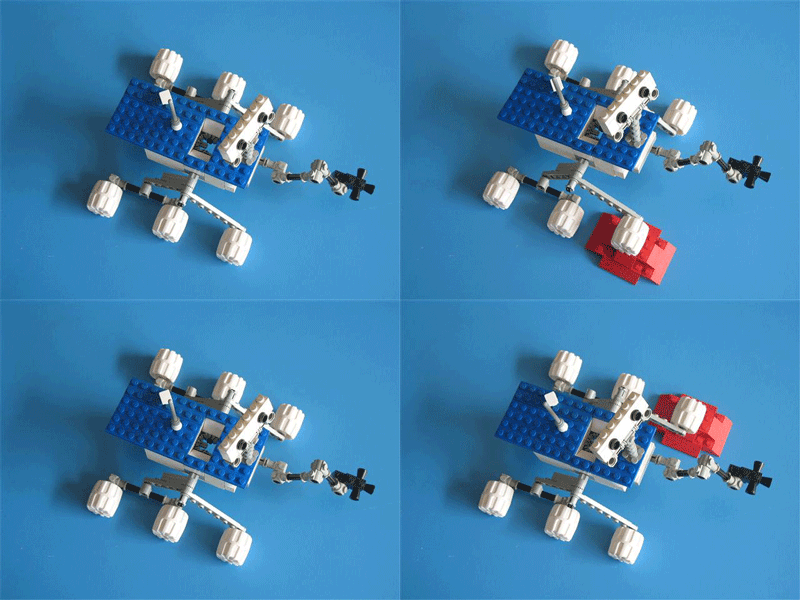
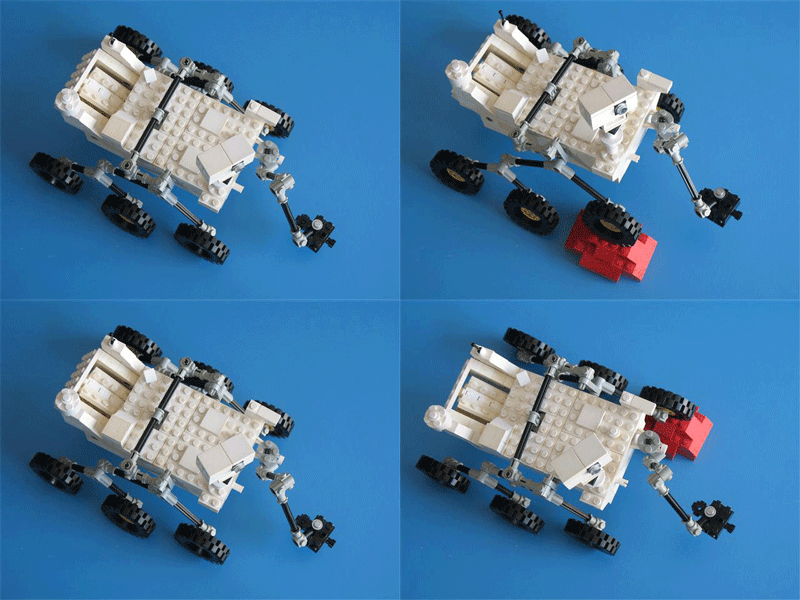
Mars Rover Rocker-Bogie Differential

Today’s is a guest post, brought to you by my father, engineer, physicist, computer programmer, and Lego, Mars, and animation enthusiast: Keith Enevoldsen. If you’re not caught by the title of the post, scroll down and look at the pictures… then scroll back up and read the rest of the article because it is fascinating stuff! (P.S. He has a website full of awesome science stuff too!)

A teaser for what you have to look forward to…

~ A l i c e !

The Rocker-Bogie

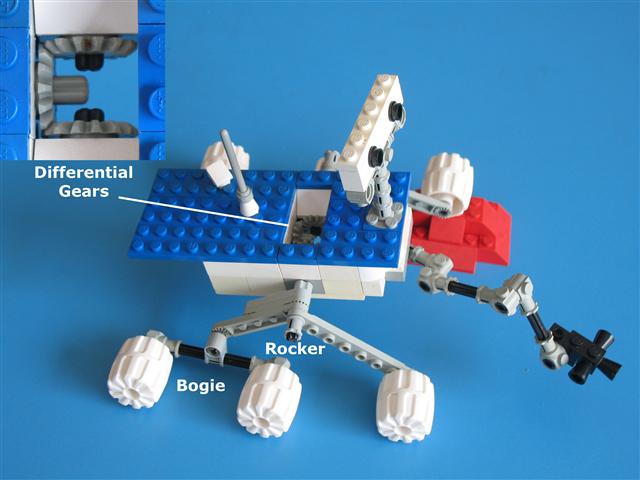
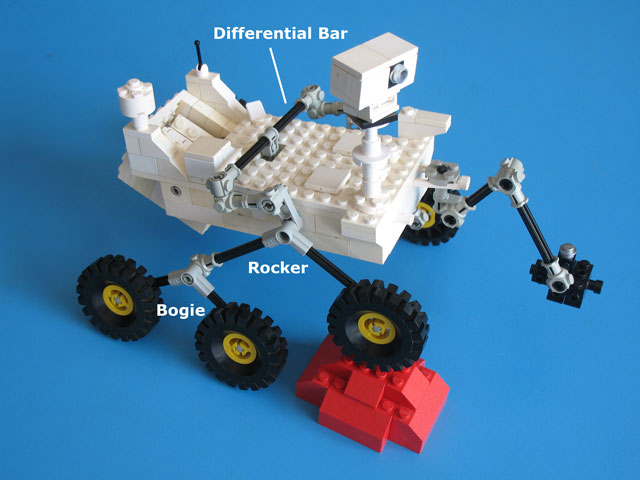
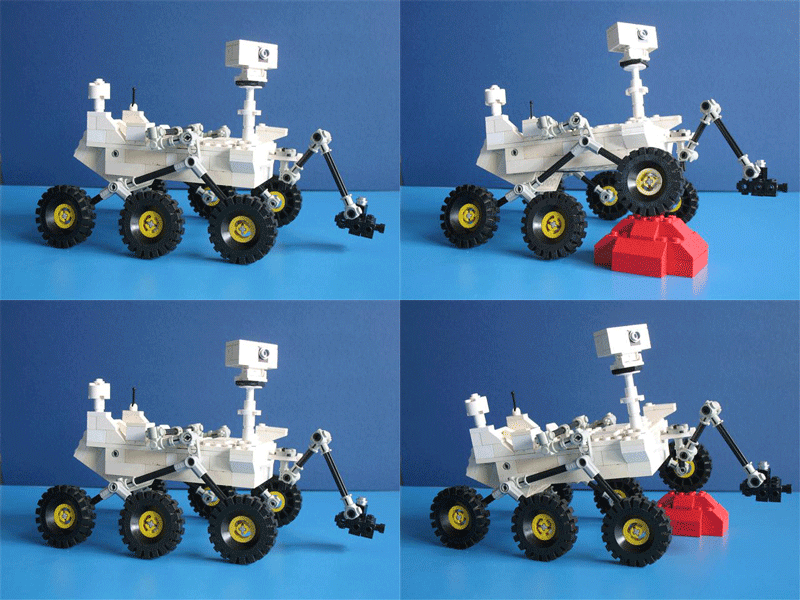
All the Mars rovers have six wheels and use a rocker-bogie suspension system to drive smoothly over bumpy ground. The rocker-bogies are easy to see in pictures of the rovers (see pictures below). There is one rocker-bogie assembly on each side of the rover. The rocker is the larger link that connects to the rover body (the chassis) in the middle (at the rocker pivot), has a wheel on the front, and connects to the bogie in the back. The bogie is the smaller link that connects to the rocker in the middle (at the bogie pivot), and has wheels at both ends. Each of the six wheels has its own motor.

The Differential

It is not so easy to see and understand how the rocker-bogie mechanism keeps the body level. What prevents the rover body from tipping all the way forward or backward around the rocker pivots? If you build a model rover and you attach the rockers to the body with an axle or two pivot pins, the body will tip forward or backward until it hits the ground! In the real rovers the two rockers connect to each other and to the body through a mechanism called a differential. The differential is what keeps the body level. Relative to the body, when one rocker goes up, the other rocker goes down. Relative to the ground, the body angle is halfway between the angles of the two rockers. That’s cool, but how does it work? The different rovers use different mechanisms: a differential gearbox or a differential bar.

Differential Gearbox

The Mars Pathfinder (Sojourner) and Mars Exploration Rovers (Spirit and Opportunity) use differential gearboxes.

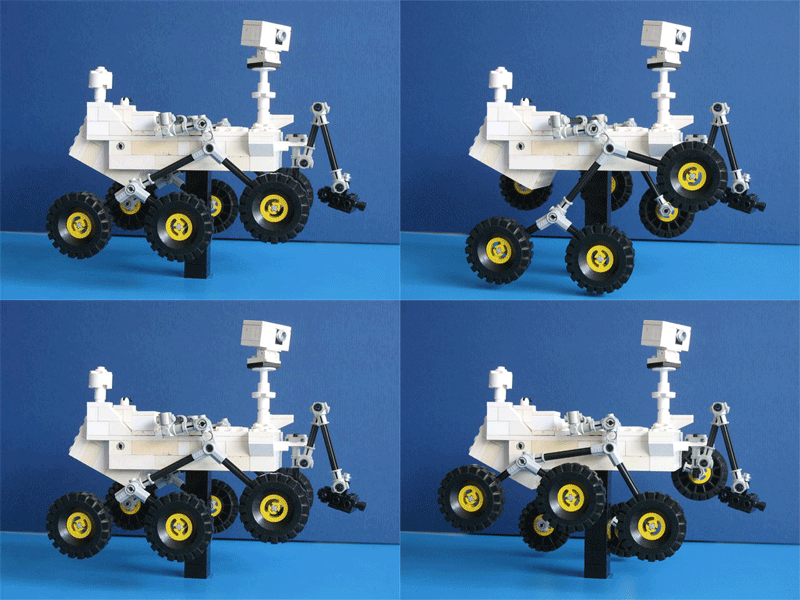
MER’s Differential
Image and Model © 2012 Keith Enevoldsen

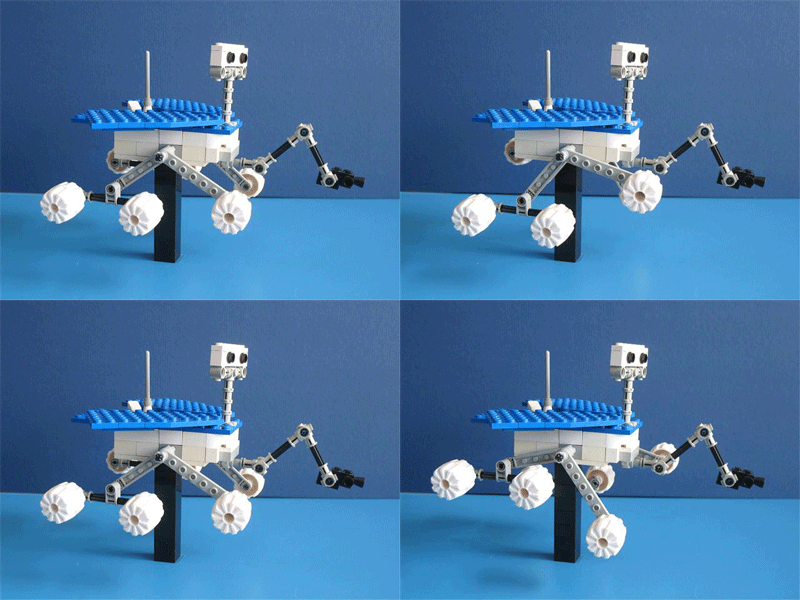
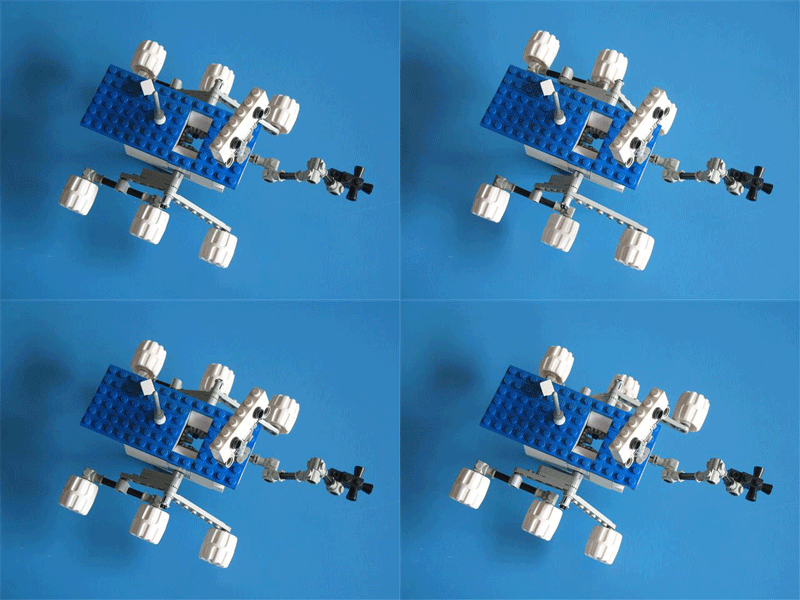
The gearbox is inside the rover body, so you never see it. No wonder it is hard to figure out how it works! In my Lego model rover shown here, I use a simple three-gear differential. Two gears connect to the two rockers and the third (middle) gear connects to the body. If you hold the model rover body steady in midair and tilt one rocker up, the gears will turn and the other rocker will tilt down (see the animations below).

The real Mars Exploration Rovers use more complicated gearboxes with more gears but they are functionally equivalent to this simple three-gear differential.

Differential Bar

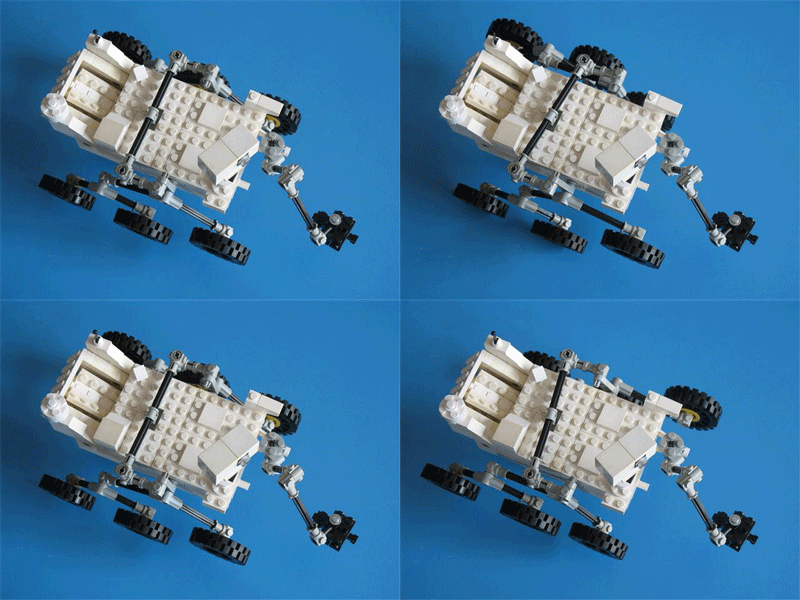
The Mars Science Laboratory (Curiosity) uses a differential bar. This is the big black bar that you see across the deck of the rover.

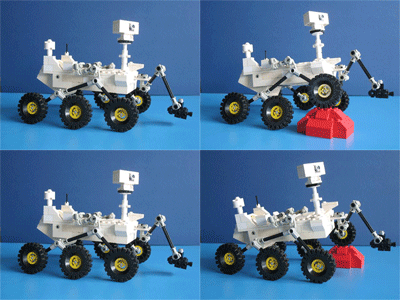
Curiosity’s Differential
Image and Model © 2012 Keith Enevoldsen

The middle of the bar is connected to the body with a pivot and the two ends are connected to the two rockers through some short links. If you hold the model rover body steady in midair and tilt one rocker up, one end of the bar will go back, the other end will go forward, and the other rocker will tilt down (see the animations below).

The Mars Exploration Rovers did not use a differential bar because it would interfere with the solar panels. But the Mars Science Laboratory does not have that problem because it is nuclear powered and has no solar panels.

Animations

Animations of a Rocker-Bogie with a Differential Gearbox

Mars Exploration Rover (Spirit and Opportunity)

Body held steady in midair:


Wheels on the ground:


Animations of a Rocker-Bogie with a Differential Bar

Mars Science Laboratory (Curiosity)
Body held steady in midair:

Wheels on the ground:


No Springs

The rocker-bogie mechanism has no springs. The absence of springs helps it keep all six wheels on the ground with approximately equal pressure on each wheel. This is a good thing when you are driving on sand!

Want More? (and References)

“Mars Exploration Rover Mobility Assembly Design, Test and Performance”, JPL

“A Capable and Temporary Test Facility on a Shoestring Budget: The MSL Touchdown Test Facility”, JPL


I hope you enjoyed my dad’s post. He sure had fun figuring out those mechanisms and creating them out of Lego!

I’ll be posting a Curiosity-landing-“watching” event here very soon.

~ A l i c e !

Science with a Twist, Astronomy Day, and Carnival of Space

First off Astronaut Greg Johnson will be at this week’s Science with a Twist on Thursday April 15th at Pacific Science Center. The event is also on Facebook. I’ll be there too, holding a brief discussion about false color, and Toni Meyers, director of Hubble 3D will be speaking about the film.

“Science with a Twist will celebrate Hubble 3D. Toni and Greg will circulate during the event and introduce the film and answer questions after the film. Pacific Science Center’s resident NASA Solar System Ambassador, Alice Enevoldsen, will  also lead you through an explanation of astronomical images: What do you see vs. What’s really there? Tickets for staff are only $17 (21 +, ID required)”

Toni Myers is the director and producer of Hubble 3D and one of the few women directors in the history of IMAX filmmaking. Toni has worked on IMAX documentaries since 1971. She has worked on every IMAX space film and has worked directly with over 120 astronauts and cosmonauts in the making of the IMAX space films. She has an extensive background in a variety of films in addition to  IMAX filmmaking .  In addition to documentary projects she has a background in the music world having worked on music projects for the Beatles’ company, Apple; and individual features and videos for John Lennon and Yoko Ono. The IMAX documentaries that Toni has worked on have been among the most successful here at the Science Center including Under the Sea 3D.   For her work on Hubble 3D  the astronauts of the STS-125 crew presented her with the Silver Snoopy Award in recognition of her excellence and

achievements in bringing the space experience to IMAX audiences around the world.

Greg Johnson graduated from West Seattle High School and from the UW  with a degree in aerospace engineering.  He received his Naval Aviator wings in December 1978.  He served as a senior research officer in Office of Naval Research. He has logged over 9500 flying hours in 50 aircraft and has over 500 carrier landings. In 1990, he was accepted as an aerospace engineer and research pilot at NASA . He joined the astronaut program in 1998. He was the pilot the final Space Shuttle mission to the Hubble Space Telescope. On this mission he logged almost 13-days in space—–traveling 5,276,000 miles in 197 Earth orbits at 17,500 miles per hour. And he was an IMAX cinematographer on the mission.

Next, April 24th will be Astronomy Day at Pacific Science Center. Here’s a copy of that e-mail:

Calling all astronomy enthusiasts!

Celebrate the 20th anniversary of the launch of the Hubble Space Telescope at Pacific Science Center on April 24th.

What: Pacific Science Center presents Astronomy Day

When: Saturday, April 24th 10am-6pm

Where: Pacific Science Center

Astronomy Day this year will be in style at Pacific Science Center! With planetarium shows, hands-on exhibits in Facing Mars, facilitated space-themed activities with our onsite Science Interpretation staff, crafts, and the eagerly-anticipated IMAX film Hubble 3D this day of science just won’t end.

IMAX FILMS

Hubble 3D

Showing April 24th at 10:30am & 11:45am

The perfect way to celebrate the 20th Anniversary of the launch of the Hubble Space Telescope is to take in a screening of this new IMAX film which is gaining rave reviews! Today’s Seattle Times review calls Hubble 3D an “extraordinary spectacle” and an “out of this world documentary.” http://seattletimes.nwsource.com/html/movies/2011381515_mr19hubble.html

Roving Mars

Showing April 24th at 11:30am, 1:30pm, 3:30pm and 5:30pm

Go behind the scenes with NASA scientists and engineers as they worked to design Mars Rovers, Spirit and Opportunity, to travel millions of miles to Mars and report back!

FEATURED EXHIBIT

Facing Mars

Open 10am-6pm

Here’s your chance to experience the sensations, emotions and conditions of a real trip to Mars without ever leaving Earth! Build your own simple rocket, take a “Mars Walk,” see firsthand what microgravity does to the human body and so much more!

Last, you should go look at Carnival of Space #149!

Okay, enough advertising. I’ll tell you more science-y stuff next week.

~ A l i c e !

Carnival of Space & Link

If you’re not currently subscribed to my new feed through feedburner you should be. It’s easy just click here, or click the orange box at the top of the page near the search bar, or input http://feeds.feedburner.com/AlicesAstroInfo into your favorite RSS feed reader.

Onward:

Carnival of Space #146 is live at Simioastronomy – check it out, lots of Hubble goodness.

Also, Seattle Astronomy Examiner Greg Schneiderer reports on my Equinox Sunset party from Saturday evening. He’s got photos in case you missed it.

~ A l i c e !

Dark Days of Winter: 365 Days of Astronomy

Ahh! I found the original post – it had slid back to 2009! Here it is …

By now my first podcast for 365 Days of Astronomy should be live, and here is the post to support it – containing links and images I mention in the podcast. So go listen already!

Also, please excuse the terrible run-on sentences and immense number of “now”‘s in the transcript. I tried to write exactly what I said, and the way I speak is significantly messier than the way I write. And I always thought I wrote the way I spoke. Hmm.

Transcript!

Telephone ring.
Hello, this is Alice. Oh hey hi, I’m glad you called. Yeah, yeah you’re right. Yesterday, January 3 was perihelion – the Earth’s closest point to the Sun. Pretty cool that that happens in winter, isn’t it? Yeah, I know, kinda mind-blowing.

Anyway the real reason I wanted you to call, I wanted to talk about the fact that January 3 was also the latest sunrise of the year. Yeah no, not December 21 the solstice, but January 3. Yeah, I always thought that the latest sunrise and the earliest sunset took place on the solstice because that’s the shortest day therefore it should have the latest sunrise and the earliest sunset. That makes sense, right? But it’s not true! The earliest sunset takes place weeks before the solstice, round about December 6th here in Seattle. That’s the earliest sunset. And the latest sunrise isn’t all the way until January 3.

So it’s kinda weird about why this is. It has to do with this thing called the equation of time. Now, you can represent the equation of time as and equation, but you can also see a representation of it by looking at an analemma. So let me tell you a little bit about how you get an analemma.

Start with noon. Think about where the Sun is at noon. Point out the window, where is the Sun at noon? Now, I hope you’re not pointing straight up because most people in the world don’t actually get to see the Sun straight up over their heads at noon – ever, any time of the year. Now, there are some. Everybody who lives between the Tropics of Cancer and Capricorn gets to see it at least one day out of the year. But the rest of us, we don’t get to see it. Generally it is going to be, if you’re in the Northern Hemisphere, it will be directly above South. Some number of degrees above South will be the highest point that the Sun gets to. And if you live in the Southern Hemisphere it will be some number of degrees above North that you’ll be able to see the Sun at noon.

Now, when it gets to that highest point in its path across the sky, that’s called astronomical noon. That’s the definition of astronomical noon. Next time you see it right there at its highest point look at your watch: probably isn’t reading noon, because we have time zones and all kinds of things like that. But also, even more importantly, that’s not the noon that really matters.

We’ve got two different kinds of time that we’re dealing with. Apparent solar time, which is what I just told you about. It’s noon when the Sun is at the highest point in the sky. You can read this with a sundial a little bit, you can also read it by measuring the angle of the Sun and making sure that it is exactly halfway across its path across the sky. So you’ve got apparent solar time, but you also have mean solar time. Now, mean solar time is what we really use in terms of determining the number of hours that have really passed. Mean solar time is if you took a clock, a perfect clock, and on the vernal equinox, March 21, you set that clock to noon the second you saw the Sun cross over the meridian – the second you saw the Sun get to its highest point – and then you let that clock run for a year, at the end of that year on the next vernal equinox, March 21, when that clock reads noon, the Sun will be right there exactly where it should be: at its highest point. Okay, so that’s mean solar time. It means that we’re averaging it out over a year.

Now the Sun, as we move around the Sun, it appears to move a little faster or a little slower through our sky because of the equation of time. Most of this is because of the eccentricity of the Earth’s orbit around the Sun. We’re not orbiting in a perfect circle. A little bit of it has to do with the tilt of the Earth, so it’s really a pretty complicated little equation, but the effects are interesting and fun.

So, we have the equation of time affecting how fast the Sun is moving across the sky. (Yes, it’s not the Sun moving, but effectively, from our point of view, while we’re watching the Sun rise and set it looks to us like the Sun is moving.) So, effectively, as the Sun is moving across the sky, some days of the year it moves a little slower and some days it moves a little faster. So, when noon comes, some days it’s behind where it should be. It’s not yet at its highest point. And some days its in front of where it should be, not yet at its highest point or, oops, past being at its highest point actually.

Now, with your perfect watch, if you go out, you set up a camera, and you take a picture of the Sun every day at noon by your perfect watch, what you’re going to see, when you put all those pictures together, is a figure-8 shape. That is the analemma, it is also a great representation of the equation of time. Okay, now if you don’t want to spend a year waiting to see that picture, just Google “analemma” or you can stop by my website: www.alicesastroinfo.com, and I’ll put up a picture for you. Also 365 Days of Astronomy will have a link up to my website from their website if that’s easier for you.

So, how does the equation of time make the earliest sunset happen before the solstice and the latest sunrise happen after the solstice? Let’s get back to that. It’s because the entire day is shifting a little bit. And I keep wanting to say it’s shifting left to right because I’ve laid out the hours on a number line, and that’s how I’m visualizing this. So, why don’t you visualize it with me? And I found it a little too complex to lay out the entire number line for a day, so I’m just using the numbers one through ten: they’re representing hours. I’m pretending we have a ten-hour day. Instead of a 24-hour day, we’ve got a ten-hour day. We’ve just got a number line: one through ten. Also, you’ve got ten fingers, so if you’re sitting on the bus, you can just hold your hands out in front of you and you’ve got that number line that you can look at.

Now, think about this: if we’ve got a solstice that’s four “hours” long, it starts at “three” and it ends at “seven.” So, the Sun rises at “three” and it sets at “seven”. So noon is at “five” there. Okay? So we’ve got a pretty short solstice day there. Now, I’m not even going to go into minutes. I’m going to say everything changes by whole hours. The day after the solstice has to be a little bit longer. So instead of being four “hours” long, it is going to have to be at least five “hours” long. All right? And, let’s go with the one that has the latest sunrise. So let’s say the sunrise is just an hour later so instead of our solstice starting at “three” we have our day starting at “four” and then you’ve got to count a five “hour” day beyond that: six, seven, eight, nine – so the Sun sets at nine. So we’ve shifted our entire day to the right.

Let’s do earliest sunset, okay? So the earliest sunset, to get our earliest sunset it’s going to have to happen before “seven” so it will have to happen at “six” which means our sunrise is going to have to happen at “one.” Now remember, these aren’t real hours we’re working with because we’re just doing a ten-hour number line. I’m just showing you how the whole day is shifting left to right. But, from “one” to “six” is once again a five-hour “day” instead of that four-hour “day” that our solstice was. And our solstice does not have the latest sunrise or the earliest sunset like that. Now, in the real world we have to deal with a lot finer methods of measuring, and it turns out these sunsets are only off by a couple of minutes from each other.

And you can look this up. I get a lot of my information from the U.S. Naval Observatory. They have a couple of great resources: one is “Sun and Moon Data for One Day,” they’ll also give you an entire year’s worth of sunrises and sunsets if you’d like, and so you can look at those. They also have a really great post called “The Dark Days of Winter” which is where I got a lot of the information for this so check that out. But in Seattle, that earliest sunset is 4:18pm. The sunset on the solstice was 4:20pm – so we’re not talking about a big difference here.

Alright, well, we’ve talked about a lot of things today. Lot of vocabulary words, and I hope you go and look some of them up. If you have any more questions give me a call. I will talk to you later. Okay, yeah. Bye!

And in case you didn’t catch that, my name is Alice Enevoldsen, I’m the planetarium specialist for Pacific Science Center in Seattle, Washington – pacificsciencecenter.org and the writer for Alice’s AstroInfo alicesastroinfo.com.

Pictures!
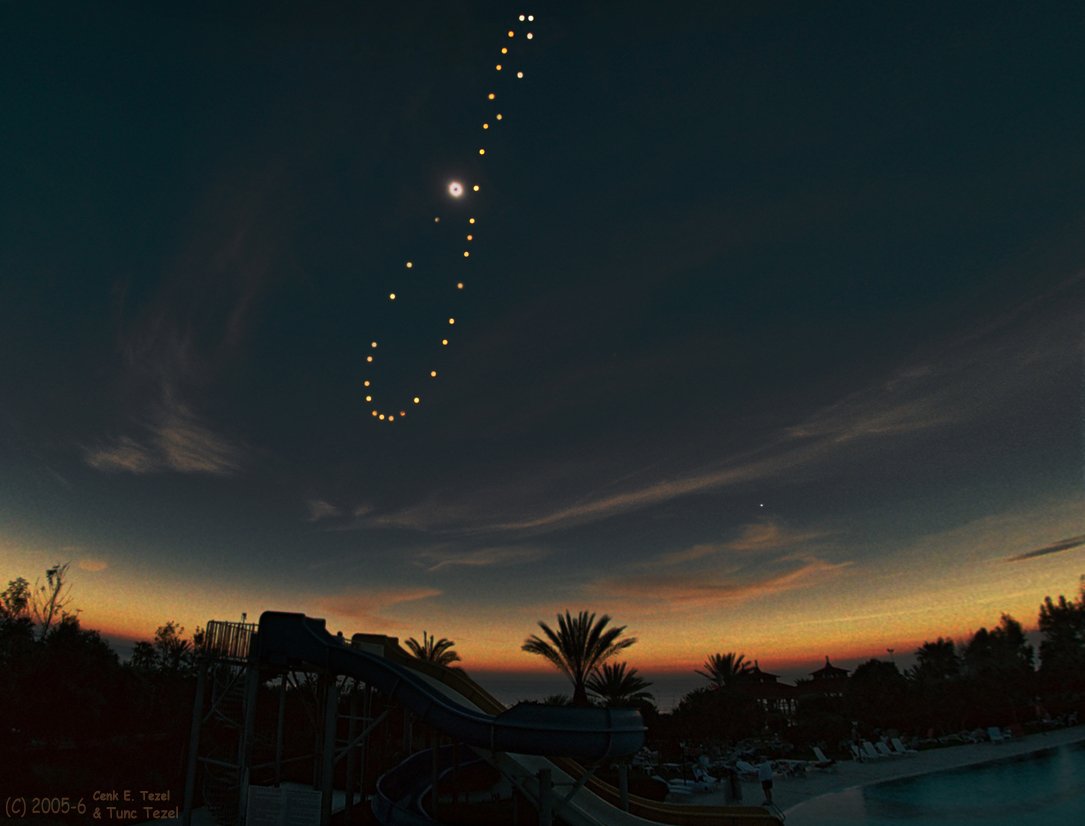
Analemma (actually a tutulemma) from NASA

Analemma (actually a tutulemma) from NASA

Links!

Pacific Science Center

U.S. Naval Observatory

Dark Days of Winter

Sun and Moon Data for One Day

Vocabulary Words!

Blerch. I used a lot of jargon in that podcast, but if you weren’t taking notes and remembered that there was a word somewhere in there that you wanted more info about, here are some of the main ideas.

Equation of Time

Analemma

Perihelion

Astronomical Noon

Tropic of Cancer

Tropic of Capricorn

Mean Solar Time

Apparent Solar Time

Meridian

Eccentricity

Today is also the first day of winter quarter, wish my students and me luck on our three-month journey.

~ A l i c e !

The ‘Cast
Carnival of Space #134

Stewart Atkinson of Cumbrian Sky is graciously hosting a holiday Carnival of Space #134. If you don’t go for any other reason, go to see his awesome space-y Christmas tree – it is what I’ve been trying to make mine look like for years. I still haven’t succeeded, though the star on top is a model of a star (our Sun).

Also, thanks to Stu for making sure everyone knows that Alice’s AstroInfo “does what it says on the tin” I think that’s hilarious. I like to think I provide information about Astronomy …

~ A l i c e !